Author
Jesús Escobar
Characteristics
328 pages; 161 colour images; hardcover, 20 x 28 cm
Publication
Spanish; translated by J. Santana Lario; originally published in English by Penn State University Press, University Park, 2022; 2025
ISBN
978-84-18760-14-3
Price
€50,00
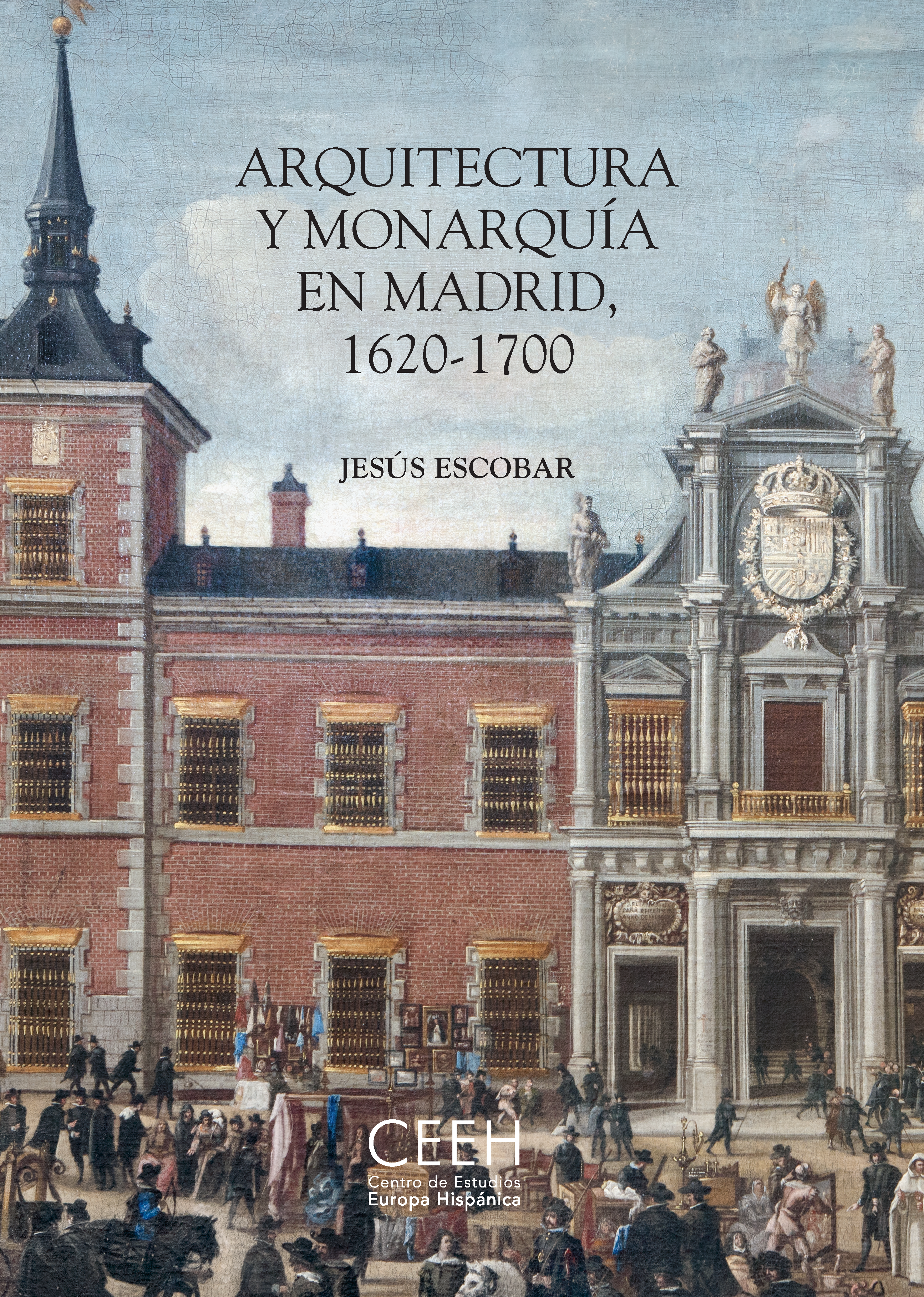
With its selection as the court of the Spanish Habsburgs, Madrid became the de facto capital of a global empire, a place from which momentous decisions were made whose implications were felt in all corners of a vast domain. By the seventeenth century, however, political theory produced in the Monarquía Hispánica dealt primarily with the concept of decline. In this book, Jesús Escobar argues that the buildings of Madrid tell a different story about the final years of the Habsburg dynasty. Madrid took on a grander public face over the course of the seventeenth century, creating a “court space” for residents and visitors alike. Drawing from the representation of the city’s architecture in prints, books, and paintings, as well as re-created plans standing in for lost documents, Escobar demonstrates how, through shared forms and building materials, the architecture of Madrid embodied the monarchy and promoted its chief political ideals of justice and good government.
The author explores palaces, public plazas, a town hall, a courthouse, and a prison, narrating the lived experience of architecture in a city where a wide roster of protagonists, from architects and builders to royal patrons, court bureaucrats, and private citizens, helped shape a modern capital. Richly illustrated, highly original, and written by a leading scholar in the field, this volume –winner of the Eleanor Tufts Award– disrupts the traditional narrative about seventeenth-century Spanish decadencia. It will be welcomed by specialists in Habsburg Spain and by historians of art, architecture, culture, economics, and politics.
Jesús Escobar, who holds a PhD from Princeton University, is Professor of Art History at Northwestern University and editor of the scholarly book series ‘Buildings, Landscapes, and Societies’, published by Penn State University Press. A scholar of art, architecture, and urbanism in early modern Spain and the larger Spanish Habsburg world, he has focused on the political and spatial evolution of Madrid from a secondary city of Castile to the seat of a global empire in the late sixteenth and early seventeenth centuries. He is the author of the award-winning book The Plaza Mayor and the Shaping of Baroque Madrid (2003).
About the original edition
“A rich, thoughtful, well-written, and even entertaining read”, Felipe Pereda, Journal of the Society of Architectural Historians
“This lavish and splendidly illustrated volume is an important addition to the literature on Spanish architecture and urbanism of the early modern era in the English-language literature”, Juan Luis Burke, CAA.Reviews
“A fascinating study of the nuances of architectural spaces, how they were used and experienced, and the co-construction of Habsburg and madrileño identity”, Jessica Weiss, Renaissance and Reformation
“A unique in-depth study of different architectures that together comprise a new and essential reading of the Madrid of the Habsburgs from the perspective of its architecture, combining the local political key with its Hispanic dimension”, Carlos Plaza, Bulletin of the Comediantes
“Hasburg Madrid is beautifully illustrated. The previously under-reproduced images of interiors, along with the plans for their reconstruction, are immensely useful for specialists. We should extend our gratitude to The Pennsylvania State University Press for this commendable commitment to Hispanic Studies and rejoice that Architectural Studies now has new material for reflection, with promising interpretative avenues”, Sergio Ramiro Ramírez, Bulletin of Spanish Studies
“A lively read and will hold great appeal for the architectural historian and architect, both of whom will sense Escobar’s own excitement about his discoveries that afford this kind of detailed analysis for the first time”, Dorothy Metzger Habel, author of “When All of Rome Was Under Construction”: The Building Process in Baroque Rome