Author
Juan Caramuel Lobkowitz; edited, translated and annotated by José Manuel Díaz Martín
Characteristics
246 pages; softcover; 17 × 24 cm
Publication
Spanish and Latin; published by Edition Reichenberger with the support of CEEH; 2025
ISBN
978-3-967280-86-9
Price
€46,15
Buy on our site and save 5% on this book until April 30
(coupon code: DÍA DEL LIBRO)
Juan Caramuel Lobkowitz (1606–1682) embodies the highest Spanish sense of leadership in the seventeenth century: he competed with Galileo in astronomy and pointed out to Descartes his errors in metaphysics; Pascal opposed him on moral issues; Bernini conspired to drive him away from Rome; and Leibniz learned from his mathematics. As a Cistercian abbot, he defended the city walls of Prague from the Protestant siege, musket in hand, subsequently restoring the faith of thousands of people who had left the Catholic church; and, as a bishop, he devoted himself to caring for the Romans during the plague epidemic. However, his political theories were silenced as a result of his public defence of the Peace of Westphalia.
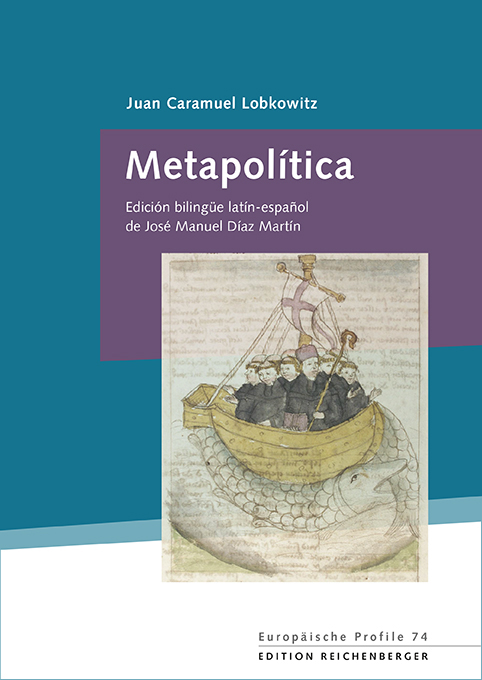
This is the first time his main work in the latter field has been published: ‘Metapolitica’, the most original and synthetical contribution of Spanish theoretical tradition to political thought, which measures itself against Hobbes’s. Every polity, from the city to the empire – he tells us – becomes understandable through the metaphor of the body, in which all members serve a purpose, connected as they are to each other and to the head that governs them. Unlike the English author’s mechanistic and individualistic version of the metaphor (which would lay the foundations for the modern State, an automaton with money at its heart and the politician as demiurge), Caramuel’s organic sense of politics kept the compound open to transcendence, and assigned a mission to the politician as a member: to preserve the warmth of the devotion of the body politic, the love that its members feel for God, for each other and for what they do, which the ruler has the mission to protect and promote.
Written in Latin around 1649, Metapolitica is therefore contemporaneous with Hobbes’s Leviathan (1651), its nemesis, and opposes what would become the latter’s hallmark (and a sign of the current times): a political power in which there is no longer any glimpse of transcendence. However, Caramuel’s criticism of the strategy of the Papacy and the Catholic Monarchy at Westphalia caused this jigsaw piece which does not fit in the history of political thought – what Caramuel termed ‘politics considered in a more subtle way, political science studied by means of a more eminent method and clarified by the highest speculations’ – to lapse into oblivion.
José Manuel Díaz Martín has rescued the text from the only extant manuscript and presents it in a bilingual edition with an introductory study after transcribing, translating and annotating it.
Juan Caramuel Lobkowitz was one of the most important and prolific intellectuals of the seventeenth century. He wrote on theology, philosophy, mathematics, astronomy, logic, linguistics and architecture. Born in Madrid, he completed his initial studies in the Imperial College (Jesuits); after becoming a Cistercian monk, he studied in the order’s Castilian monasteries and at the universities of Alcalá, Salamanca and Leuven; he travelled throughout Europe holding various ecclesiastical positions and ending his days as bishop of Vigevano (Italy). He took part in the debates that led to the Peace of Westphalia (1648) and, as an expert in ballistics, made a decisive contribution to defending Leuven and Prague from the Protestant sieges. He corresponded and debated with some of the foremost intellectuals of his time (Descartes, Nieremberg, Pascal, Gassendi and Kircher, among others). His vast and original oeuvre includes Theologia moralis, a landmark work that was an essential subject of discussion in its time from the first edition (1645) onwards; Theologia rationalis, which includes a pioneering treatise on grammar; and Mathesis biceps (1670), in which he presented the first credentials of the binary system and probability calculus. Much remained unpublished.
José Manuel Díaz Martín holds a degree in Law (Alicante and Bologna), a diploma in Political Science and Constitutional Law (CEPC, Madrid) and a PhD in Philosophy (Balearic Islands). He works as a bibliographer in charge of the early holdings of the Biblioteca Diocesana in Mallorca. After a period teaching constitutional law, he is currently devoted to independent research. His publications focus on the theology of the Augustinians and Christians of Jewish origin in Spain (15th–17th centuries), and on the integration of Spanish thought into the European context of the 18th century. He is the author of La responsabilidad política en los sistemas democráticos [Political Responsibility in Democratic Systems] (2001) and Leyendo a fray Luis de León [Reading Fray Luis de León] (2014). He has also edited Fray Luis de León’s lessons Tratado sobre la gracia y la justificación [Treatise on Grace and Justification] (2008) and Cuestiones sobre la Encarnación [Questions on the Incarnation] (2018).