Author
Silvia Z. Mitchell
Characteristics
328 pages; 97 colour illustrations; hardcover, 20 x 28 cm
Publication
Spanish; translated by I. García Ureta and I. Morán García; originally published in English by Penn State University Press, University Park, 2019; 2023
ISBN
978-84-18760-09-9
Price
€50,00
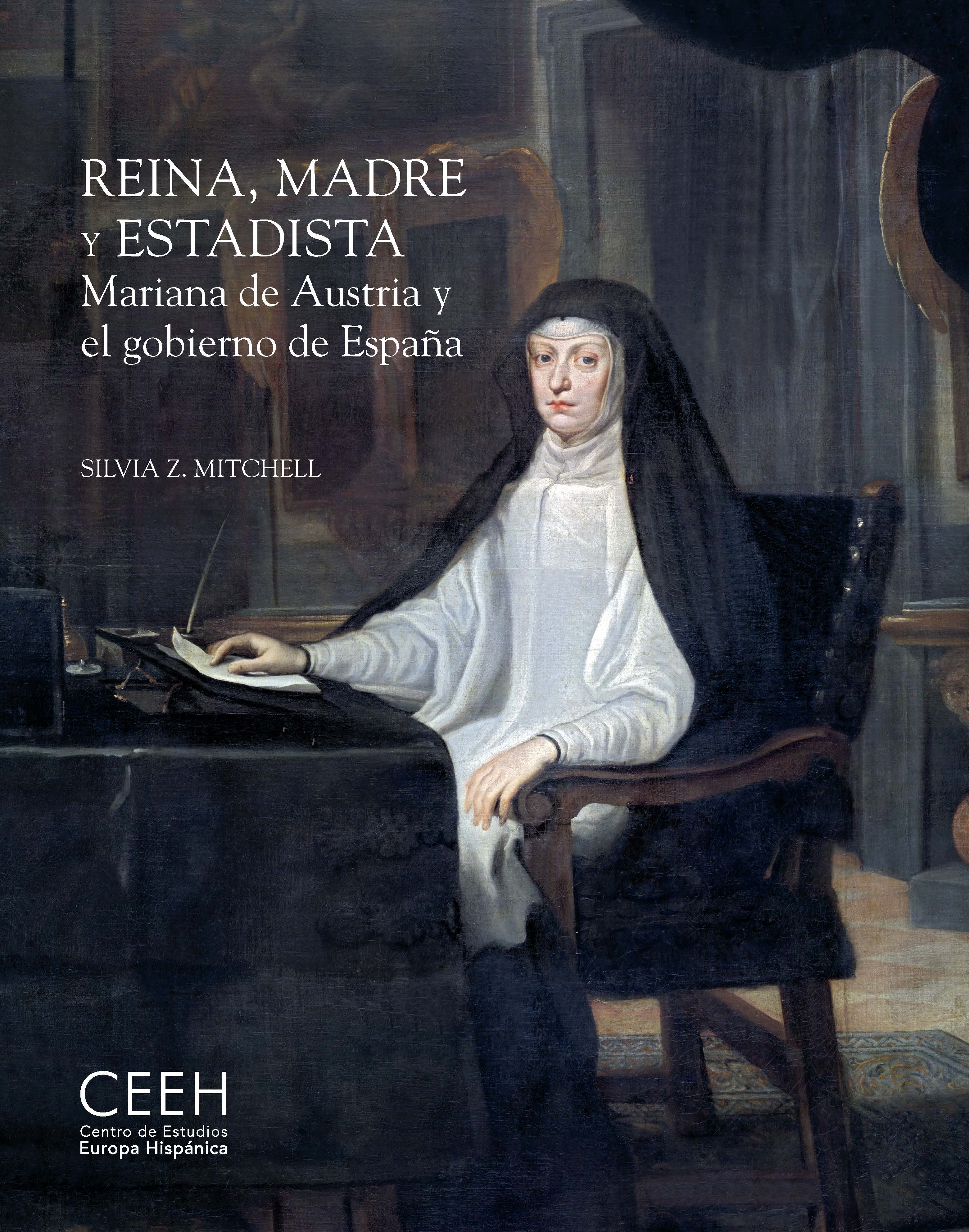
When Philip IV of Spain died in 1665, his heir, Carlos II, was three years old. In addition to this looming dynastic crisis, decades of enormous military commitments had left Spain a virtually bankrupt state with vulnerable frontiers and a depleted army. In Reina, madre y estadista. Mariana de Austria y el gobierno de España, Queen Regent Mariana of Austria emerges as a towering figure at court and on the international stage, while her key collaborators — the secretaries, ministers, and diplomats who have previously been ignored or undervalued — take their rightful place in history. Mitchell provides a nuanced account of Mariana of Austria’s ten-year regency (1665–75) of the global Spanish Empire and examines her subsequent role as queen mother, refuting the general narrative that she was a weak and manipulable woman, too young to rule.
Drawing from previously unmined primary sources the author offers a new narrative of the Spanish Habsburg monarchy in the later seventeenth century, advancing our knowledge of women’s legitimate political entitlement in the early modern period. Mariana, who inherited a court deeply divided over the Portuguese conflict took on the reins of the Spanish Empire without hesitation and shaped the court to fulfill the needs of her regime. She surrounded herself with trusted figures but never surrendered her power to them. Over the course of her regency, Mariana — presented here as one of the most influential figures in European politics along with Louis XIV, Charles II of England, and Emperor Leopold I among others — led the Monarchy out of danger and helped redefine the military and diplomatic blocs of Europe in Spain’s favor.
Silvia Z. Mitchell, who received her Ph.D. from the University of Miami (Florida), is an associate professor at Purdue University (Indiana) and a member of the CINTER (Court, Image, Nobility, and Territory) research group at the Universidad Rey Juan Carlos, Madrid. Her research focuses on the history of the Spanish Monarchy and the women of the royal House of Habsburg from political, cultural, and dynastic perspectives. She is currently preparing a monograph on the Spanish Habsburgs (1500-1700).
About the original edition
“Contains many insights that help us to understand a very complex series of events. This is an important book that people will want to read. It will be invaluable for undergraduate courses on Spanish and European history, as well as an essential point of reference for future research into the exciting world of early modern Spanish political and cultural history”, Alistair Malcolm, Bulletin of Spanish Studies
“An impressive work of scholarship that adds a great deal not only to our knowledge of late Hapsburg Spain, but also to the field of queenship studies by increasing our understanding of both the life of this formidable royal woman and the mechanisms and challenges of female regency itself”, Elena Woodacre, Royal Studies Journal
“Built upon a base of impressive archival research, Mitchell has provided an illuminating analysis of a ruler whose historical reputation has been the victim of incomplete, stereotypical, and even misogynist characterizations”, Elizabeth A. Lehfeldt, Renaissance Studies
“An imaginative and wholly original account of a ruler who is regarded as the personification of Spain’s seventeenth-century decline as an imperial power. Mitchell revises the traditional view of Mariana as the hapless pawn of her confessors and male courtiers and shows her to be a fiercely independent woman capable of decisive action in domestic and foreign affairs as well as a ruler who successfully managed to defend the interests and reputation of Spain’s Habsburg monarchy. This book is a valuable contribution to the growing body of literature on early modern queenship”, Richard L. Kagan, autor de Los Cronistas y la Corona. La política de la Historia en España en las Edades Media y Moderna
“Countering the common perception of Mariana de Austria as weak, too young to govern, and easily manipulated, Silvia Mitchell demonstrates that Mariana was a forceful, effective regent during the period of her son’s minority (1665-75). Grounded solidly in fresh archival research, Queen, Mother, and Stateswoman will advance the historical debate on Mariana, on seventeenth-century royal favorites, and on the court of Charles II of Spain”, Magdalena Sánchez, author of The Empress, the Queen, and the Nun: Women and Power at the Court of Philip III of Spain
“Mitchell mines court archives and state records to demonstrate that Mariana of Austria had clear and consistent diplomatic and military strategies as queen regent, and he establishes her as part of a long tradition of strong female leadership in early modern European courts. This work fills a significant gap in our understanding of the late seventeenth-century Spanish court and supports recent arguments in favor of Spanish resilience rather than decline under the last Habsburgs”, Jodi Campbell, author of At the First Table: Food and Social Identity in Early Modern Spain
“Silvia Mitchell’s work is an important revisionist study of the regency of Mariana of Austria, mother of the last Spanish Habsburg. Based upon wide-ranging and detailed research, it has considerable implications for a much more positive understanding than has prevailed hitherto not only of the last decades of Habsburg rule in Spain but also, more broadly, of female political agency in early modern Europe”, Christopher Storrs, author of The Resilience of the Spanish Monarchy, 1665–1700
“Mit der weitgehenden Revision älterer Bilder vom Handeln einer Regentin steht Mitchells Buch zugleich in einer Reihe mit kürzeren wie längeren Untersuchungen, die immer wieder nachweisen, wie stark unser Blick auf dynastische Herrschaft und die Relevanz von Frauen in diesem Kontext bis heute von Sichtweisen des 19. Jahrhunderts bzw”, Katrin Keller, Zeitschrift für Historische Forschung—Redaktion
“Die Untersuchung dieser Regentin am Vorabend des Spanischen Erbfolgekrieges aber einen wichtigen Beitrag zur spanischen und habsburgischen Geschichte und zur Geschlechtergeschichte und kann als Ausgangpunkt für einen internationalen Vergleich dienen”, Elena Taddei, Sehepunkte
“This book sets out to explore and answer certain questions pertaining to regency, agency, favouritism and motherhood, and satisfactorily delivers”, Jonathan Spangler, Journal of Ecclesiastical History
“Mitchell’s book uses a microhistorical approach to comprehend larger questions, such as the political and diplomatic situation of the Spanish Monarchy during the second half of the seventeenth century. She also employs methodology from gender studies and queenship that allows her to shed light on new and insightful aspects of Mariana’s regency which have not been studied”, Valentina Marguerite Kozák, The Middle Ground Journal