Author
Richard L. Kagan
Characteristics
492 pages, 13 black and white illustrations; flapped paperback; 14.5 x 22 cm
Publication
Spanish; Spanish translation by Pablo Sánchez León of the book originally published in English by The Johns Hopkins University Press in 2009 jointly published with Marcial Pons; 2010
ISBN
978-84-92820-32-0
Price
€26,92
Monarchs throughout the ages have commissioned official histories that cast their reigns in a favorable light for future generations. These accounts, sanctioned and supported by the ruling government, often gloss over the more controversial aspects of a king’s or queen’s time on the throne. Instead, they present highly selective and positive readings of a monarch’s contribution to national identity and global affairs.
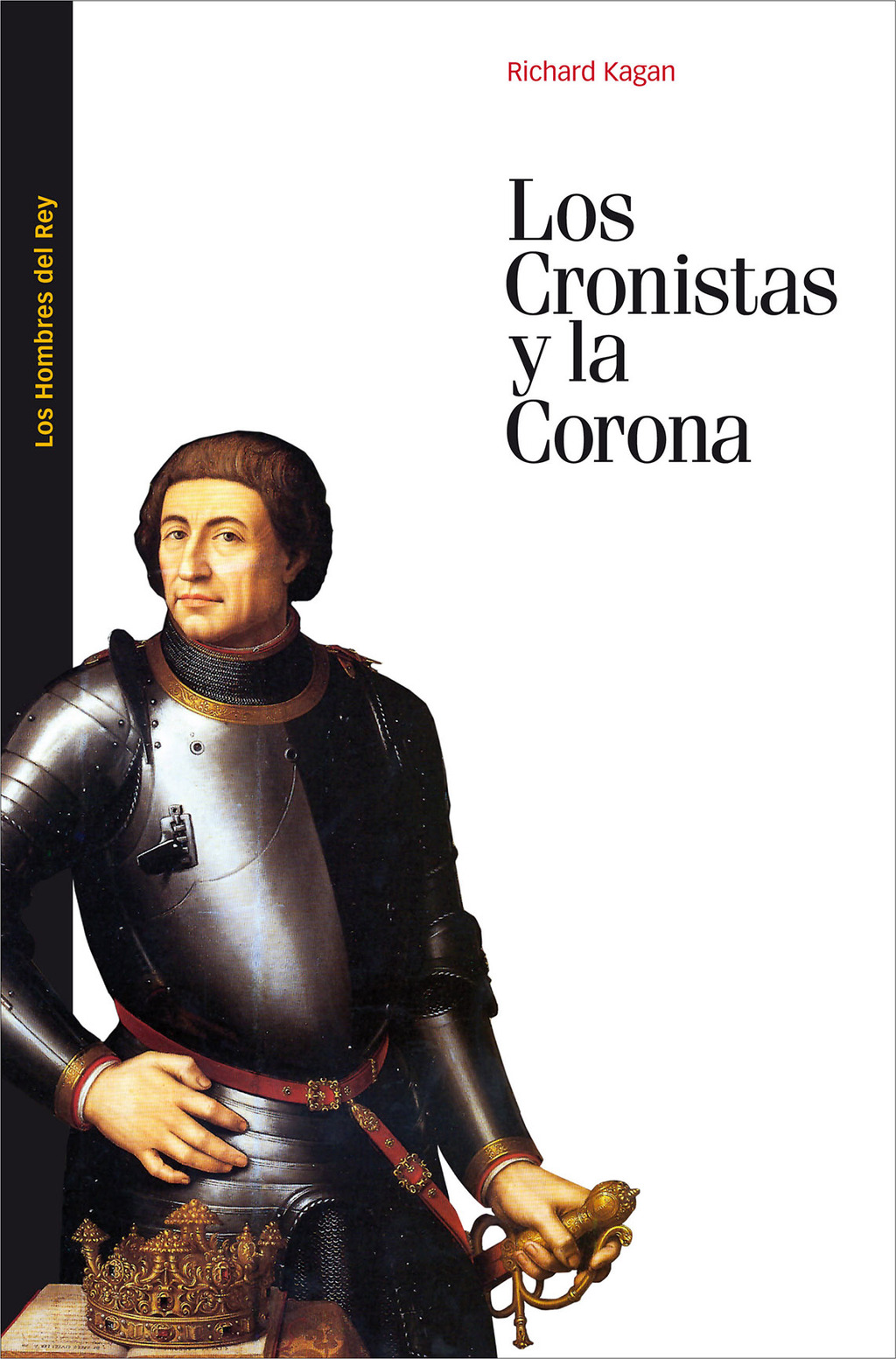
In Los Cronistas y la Corona, Richard L. Kagan examines the official histories of Spanish monarchs from medieval times to the middle of the 18th century. He expertly guides readers through the different kinds of official histories commissioned: those whose primary focus was the monarch; those that centered on the Spanish kingdom as a whole; and those that celebrated Spain’s conquest of the New World. In doing so, Kagan also documents the life and work of individual court chroniclers, examines changes in the practice of official history, and highlights the political machinations that influenced the redaction of such histories.
Just as world leaders today rely on fast-talking press officers to explain their sometimes questionable actions to the public, so too did the kings and queens of medieval and early modern Spain. Monarchs often went to great lengths to exert complete control over the official history of their reign, physically intimidating historians, destroying and seizing manuscripts and books, rewriting past histories, and restricting history writing to authorized persons.
Still, the larger practice of history writing—as conducted by nonroyalist historians, various scholars and writers, and even church historians—provided a corrective to official histories. Kagan concludes that despite its blemishes, the writing of official histories contributed, however imperfectly, to the practice of historiography itself.
Richard L. Kagan is Arthur O. Lovejoy Professor Emeritus of History and Academy Professor at the Johns Hopkins University. With degrees from Columbia University (BA) and Cambridge University (PhD), he is a member of the American Philosophical Society, Corresponding Member of Spain’s Real Academia de la Historia, and Comendador in Spain’s Orden de Isabel la Católica. Kagan has published essential studies on Habsburg Spain and its overseas empire, as well as Spain’s artistic and cultural relations with the United States. He has also written and edited important works such as Ciudades españolas del Siglo de Oro: las vistas españolas de Anton Van den Wyngaerde (1986); Spain, Europe and the Atlantic World (with Geoffrey Parker; 1995; Spanish edn. 2001); Atlantic Diasporas: Jews, Conversos, and Crypto-Jews in the Age of Mercantilism, 1500–1800 (with Philip D. Morgan, 2009), and is the translator and editor, with Abigail Dyer, of Inquisitorial Inquiries: Brief Lives of Secret Jews and Other Heretics (2011).
“Un estudio sólido y completo”, Franco Luciano Tambella, Revista Escuela de Historia
About the original edition
“A new book by Richard L. Kagan is always a welcome event. One of the most learned and interesting historians of early modern Spain, Kagan now offers an elegantly written and exquisitely researched study of official government-sponsored histories of the Spanish monarchs”, Patricia E. Grieve, The American Historical Review
“With his usual engaging narrative style, Kagan avoids the dangers of converting his book into a long prosopographical list of historians, instead offering a clear panorama of the projects and fundamental information about lesser-known historians who transformed and translated the past into political statements”, Fabien Montcher, Renaissance and Reformation
“Kagan gives shape to an adversarial process among Spanish historians, royal advisers, and rulers to establish some measure of objective truth, ever so elusive, in official, commissioned histories of Spain’s kings between the late Middle Ages and the reign of Charles II… This work provides fascinating, welcomed research on writing official history behind the scenes. Highly recommended”, Choice
“Researched and written with characteristic skill and grace, Clio and the Crown offers a much-needed survey of the social and intellectual milieus in which scholars from Rodrigo Jiménez de Rada in the thirteenth century to Juan Bautista Muñoz in the eighteenth labored to create a national historiography suitable to the needs of the Spanish court”, Adam G . Beaver, Renaissance Quarterly
“Deeply researched and well-written work… Both the book and its extensive bibliographies of primary and secondary sources will therefore remain indispensable to future researchers for years to come”, American Academy of Research Historians of Medieval Spain Newsletter
“Clio and the Crown is a considerable achievement for the understanding of history in the Renaissance and its aftermath”, John M. Headley, Journal of Modern History
“An indispensable tool for understanding the evolution of official histories commissioned by Spanish monarchs, their idiosyncrasies regarding what kind of history needed to be written, and the uses of history to defend Spain’s imperium in the New World”, The Year’s Work in Modern Language Studies