Autor
M. Elizabeth Boone
Características
320 páginas; 100 ilustraciones en color; cartoné al cromo; 21 × 24 cm
Publicación
Español; traducción de J. Santana Lario (versión original inglesa Penn State University Press, University Park, 2020); coeditado por el CSA y el CEEH; 2022
ISBN
978-84-18760-07-5
Precio
37,50 €
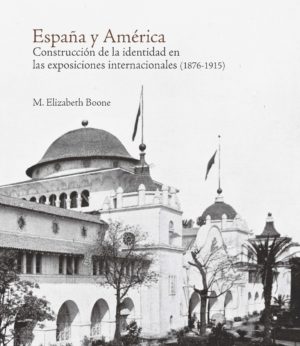
Durante mucho tiempo, España y América han utilizado las exposiciones internacionales para crear, promover, modificar e impugnar su identidad nacional. Este libro analiza la participación española en algunas de ellas, centrándose sobre todo en las de 1876, 1893 y 1915 celebradas en Estados Unidos; en las ferias de 1888 y 1889 de Barcelona y París; y en las conmemoraciones de la independencia que tuvieron lugar en Buenos Aires, Ciudad de México y Santiago de Chile a lo largo de 1910. Al estudiar las obras pictóricas, las arquitecturas efímeras y otras manifestaciones de la cultura visual, la autora señala la rica y poco conocida historia de la producción española al otro lado del Atlántico. Al mismo tiempo, deja al descubierto el elemento español en la identidad nacional de Estados Unidos pese a los intentos de este país por marginar y oscurecer la importancia de España en su historia, y disecciona los mecanismos a través de los cuales los americanos, desde Santiago de Chile hasta Chicago o San Diego, se sirvieron de las exposiciones enviadas por España para modelar su propia imagen contemporánea.
M. Elizabeth Boone ocupa la cátedra de Historia del Arte, del Diseño y la Cultura Visual en la Universidad de Alberta (Canadá). Es especialista en la historia del arte en Estados Unidos, España e Hispanoamérica durante los siglos XIX y XX. En los últimos tiempos investiga sobre la exhibición de animales en ferias y exposiciones en Europa y América.
«Amplía y actualiza los estudios en habla inglesa sobre España y las artes en el siglo XIX a través de una concienzuda búsqueda de fuentes de muy variada naturaleza», Pablo Sánchez Izquierdo, Camino Real
Sobre la edición original
«[This book] illuminates American ideological objectives in the representation of national pasts through international and commemorative fairs and, perhaps more importantly, invites us to be alert to other ways and moments in which the United States shares a history and aesthetics with Spanish and Latinx cultures», Alisa Luxenberg, Bulletin of the Comediantes
«Special attention is devoted to Spanish art in the 19th century—presented through remarkable plates and photographs—including paintings, architectural displays, and rare materials», N. Greene, Choice
«Boone confirms her role as the leading interpreter of the complex interactions between the United States and Spain as revealed in the visual arts. This thoroughly researched analysis of key international expositions held between 1876 and 1915 demonstrates the nuances of these trans-Atlantic relations and provides insight into Hispanic/Latinx identity and presence in the United States over a century later», Katherine Manthorne, editora de California Mexicana: Missions to Murals, 1820-1930
«Pioneering in every respect, this handsomely-illustrated volume offers unique insights into the extent to which political circumstances, combined with long-standing racial and religious prejudices, frustrated Spain’s campaign for recognition of the artistic and creative genius of its people at various world’s fairs. The volume is a must for anyone interested in Spain’s modern history along with those concerned with attitudes towards the place of both Spanish and Hispanic culture in the United States», Richard L. Kagan, autor de Urban Images of the Hispanic World, 1493-1793
«A meticulously researched and engagingly written account of the genesis, the promotion, and also the avoidance of Spanish identity and culture, including in Spain’s former colonies. This impressive book is a major contribution to transnational cultural studies, demonstrating Boone’s deep and nuanced command of Spanish, Latin American, and U.S. art and culture», Barbara Brinson Curiel, Humboldt State University
«It mines a wealth of visual and textual evidence from the later 19th and early 20th century world’s fairs in order to convincingly demonstrate Spain’s marginalization in the construction of an American identity that leaned more heavily toward England. While well-versed in theoretical approaches to its subject and detailed in unraveling the complexities of Spain’s reception at world’s fairs, Boone’s book remains grounded in a careful examination of the fine arts and material culture, and how the visual arts functioned politically in an international context», David Raizman, coeditor de Expanding Nationalisms at World Fairs: Identity, Diversity and Exchange, 1851-1915
«A wonderfully detailed investigation of the shaping of Spain’s national-ethnic identity through several key international exhibitions with art in the United States and Latin America. Drawing upon unpublished archival sources, the engaging study analyzes the strategies of, and the international stakes for administrators, statespersons, and critics from different nations. This book offers readers an indispensable understanding of the politics of display in the creation and reception of these exhibitions», Oscar E. Vázquez, autor de The End Again: Degeneration and Visual Culture in Modern Spain
«This book is groundbreaking and an important tool in helping us all get a richer, more complete, and much more realistic view of the Spanish past and contributions to making the United States what it was to become», David M. Sokol, Journal of American Culture
«This book offers the interested reader an excellent gateway to think visual cultures in dialogue with the objective of the nations at the time of the composition of collections that synthesized national imageries and, at the same time, to discover which elements were included and excluded in the consolidation of those canons. From my perspective, it is, in turn, a contribution to think the construction of national patrimony in a way that is more dynamic and attentive to quite different elements and actors», Paula Bruno, Tapuya
«A welcome contribution during an important historical moment, when the US relationship to its Hispanic heritage and present-day culture is being reconfigured. July 29, 2020, marked the establishment of the National Museum of the American Latino with the approval of the US Congress, as part of the omnibus spending bill. Drawing on the visual culture of the nineteenth-century World’s Fairs, Boone’s book puts in perspective the historical origins of the tension between the US and its Spanish roots», Maria Dorofeeva, Nineteenth-Century Art Worldwide
«A must-read revisionist project of great urgency for Americanists, Latin Americanists, and Iberianists who wish to better understand the interconnectedness of their cultural histories and to shape more inclusive scholarship», Alba Campo Rosillo, Winterthur Portfolio
«[The Spanish Element in Our Nationality] is an informative work and a mustread for individuals interested in art history, world’s fairs, immigration to the United States, and US-Spanish-Latin American relations at the turn of the twentieth century», Gregg French, RACAR: Canadian Art Review